
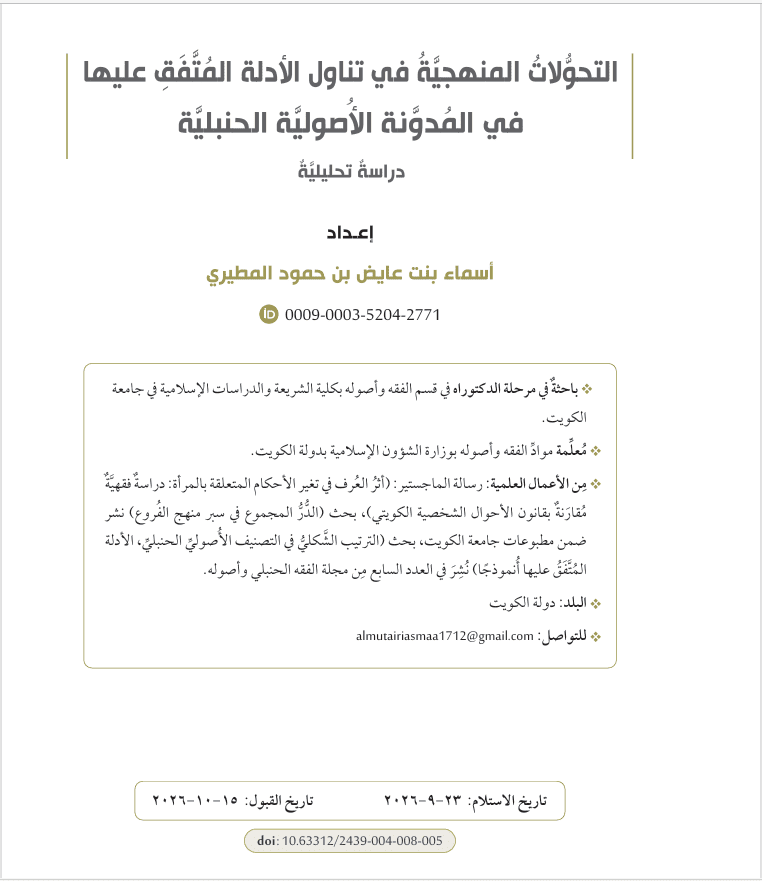
Methodological Shifts in the Treatment of the Agreed-Upon Sources of Islamic Law in Hanbali Works on Islamic Legal Theory: An Analytical Study.
DOI:
https://doi.org/10.63312/2439-004-008-005Keywords:
Islamic Legal Theory (Usul al-Fiqh), Hanbalis, Agreed-Upon Sources of Islamic Law, Methodological Shifts, Qur'an, Sunnah, Consensus (Ijma'), Analogical Reasoning (Qiyas)Abstract
-
Research Subject: This study traces methodological shifts in the treatment of the agreed-upon sources of Islamic law—the Qur'an, Sunnah, consensus (ijma'), and analogical reasoning (qiyas)—in works representing successive stages of Hanbali Islamic legal theory (usul al-fiqh). It examines their effects on the organization of legal-theoretical material, the classification of issues concerning the sources, and their functions in legal reasoning.
-
Research Problem: Changes in arrangement and the addition of issues alone cannot explain the development of legal-theoretical writing without identifying shifts in the classification of issues concerning the sources, the definition of points of disagreement, and each source's function in legal reasoning. The study asks: What principal methodological shifts characterize the treatment of these sources in Hanbali legal-theoretical works?
-
Methodology: The study employs inductive and comparative analytical methods, taking account of the chronological sequence of the works.
-
Results: Shifts affected the formulation and classification of issues concerning the sources, the clarification of their grounds, and their functions in legal reasoning, even where legal-theoretical positions remained unchanged. The Hanbali corpus shows diverse approaches, beginning with formulating principles from Imam Ahmad's transmitted positions, followed by expanded analysis, the elaboration of subsidiary issues, and dialectical testing of legal reasoning. Subsequent developments include Ibn Qudamah's refinement and reorganization of material, Shaykh Taqi al-Din's internal critique of certain criteria, and al-Mardawi's and Ibn al-Najjar's clarification, correction, and comprehensive incorporation of inherited scholarship. These shifts involved methodological borrowing from other schools: Hanafi influence on some of Abu Ya'la's methods of dialectical argumentation, causal reasoning (ta'lil), and juristic preference (istihsan). The approach of the theologians (tariqat al-mutakallimin) influenced Abu al-Khattab, Ibn 'Aqil, and Ibn Qudamah. These legal theorists adapted such influences within the Hanbali framework, developing its corpus while preserving its doctrinal identity.
Downloads
References
Additional Files
Published
Issue
Section
License