
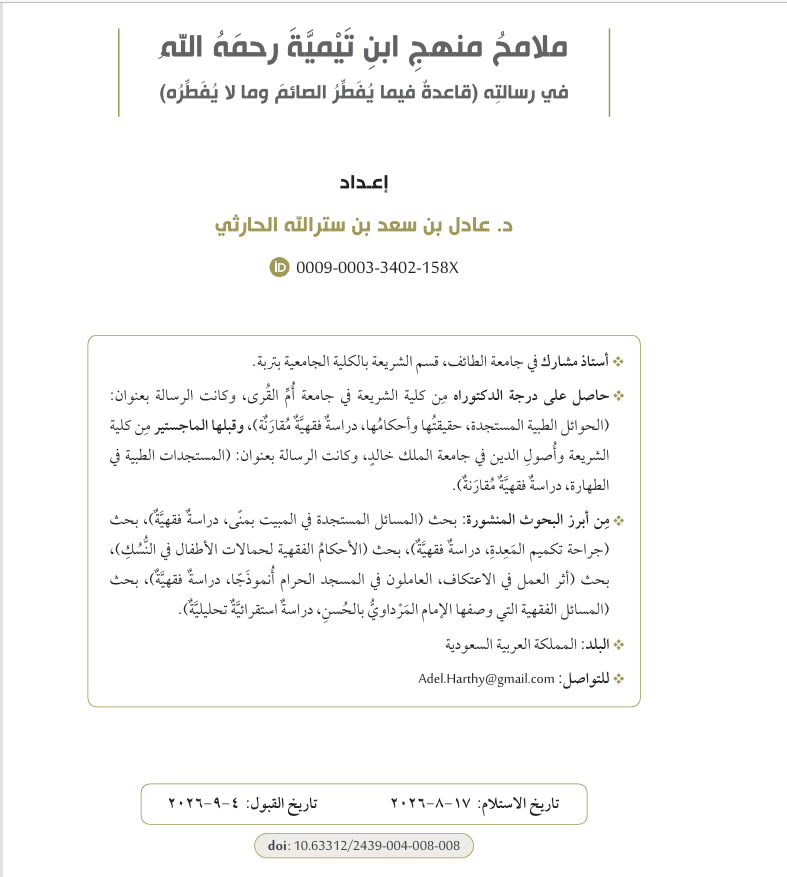
Features of the Methodology of Ibn Taymiyyah (may Allah have mercy on him) in His Treatise "A Rule Concerning What Invalidates the Fast and What Does Not"
DOI:
https://doi.org/10.63312/2439-004-008-008Keywords:
Ibn Taymiyyah, Matters That Invalidate the Fast (Muftirat), Invalidators of Fasting (Mufsidat al-Sawm), Method of Legal Reasoning (Manhaj al-Istidlal)Abstract
-
Research Subject: This study identifies the methodological features of the treatise, introducing its subject, significance, overall contents, and Ibn Taymiyyah's approach. It explains that the treatise falls within the Book of Fasting, specifically the chapter on "What Invalidates the Fast and Necessitates Expiation (Kaffarah)." Its importance lies in its discussion of matters that invalidate the fast, the scholarly stature of its author, and its frequent use in teaching and commentary by contemporary scholars.
-
Methodology: The study employs the analytical method.
-
Results: Ibn Taymiyyah's methodology is evident in his attention to textual and rational evidence; his collection of hadiths and transmitted reports (athar) relevant to each issue; his citation of the foundational hadiths on the subject; his consistency in presenting arguments and adopting juristic positions; and his detailed discussion of the grounds for preferring one view over another (tarjih). He bases rulings on legal maxims, principles, and objectives (maqasid), cites analogous and comparable cases (al-ashbah wa al-naza'ir), classifies issues, and proceeds from an overview to detailed exposition.
-
Recommendations: The study recommends careful engagement with Ibn Taymiyyah's scholarly legacy and thoughtful selection of works to study, beginning with short texts and reading them repeatedly until the reader becomes familiar with his method and style and benefits fully from them.
Downloads
References
Additional Files
Published
Issue
Section
License